Vintage watches
Rolex Explorer 1016: the watch that conquered Everest
Olivier Guesdon · · 3 min read

In the world of collectible watchmaking, some watches go beyond their simple function to become true historical symbols. The Rolex Explorer 1016 is one of those rare timepieces whose legend was built in the extreme and in the timeless alike.
Born of exploration and shaped by demanding standards, it is considered today one of the absolute holy grails of vintage Rolex.

The origins: when exploration dictates watchmaking
It is the early 1950s. The world is looking toward the still-unclimbed summits, and Everest represents the ultimate challenge. Conditions are extreme: freezing cold, minimal atmospheric pressure, shocks, humidity. Instruments must be reliable, legible and robust.
Rolex supports several Himalayan expeditions, including that of Sir Edmund Hillary and Tenzing Norgay in 1953. While the debate continues over the exact model worn on the final ascent, one thing is certain: these expeditions gave birth to a watch designed for adventure, which would soon take the name Explorer.
The birth of an icon: reference 1016
Introduced in 1963, the Rolex Explorer reference 1016 marks a decisive turning point. It succeeds references 6350 and 6610, but it is the one that truly anchored the Explorer in watchmaking legend.
Produced for more than 25 years (until 1989), the 1016 embodies a philosophy rare at Rolex: “If it isn’t broken, don’t fix it.”

A design of absolute purity
The Rolex Explorer 1016 stands out for its radical restraint, which has become its greatest strength today.
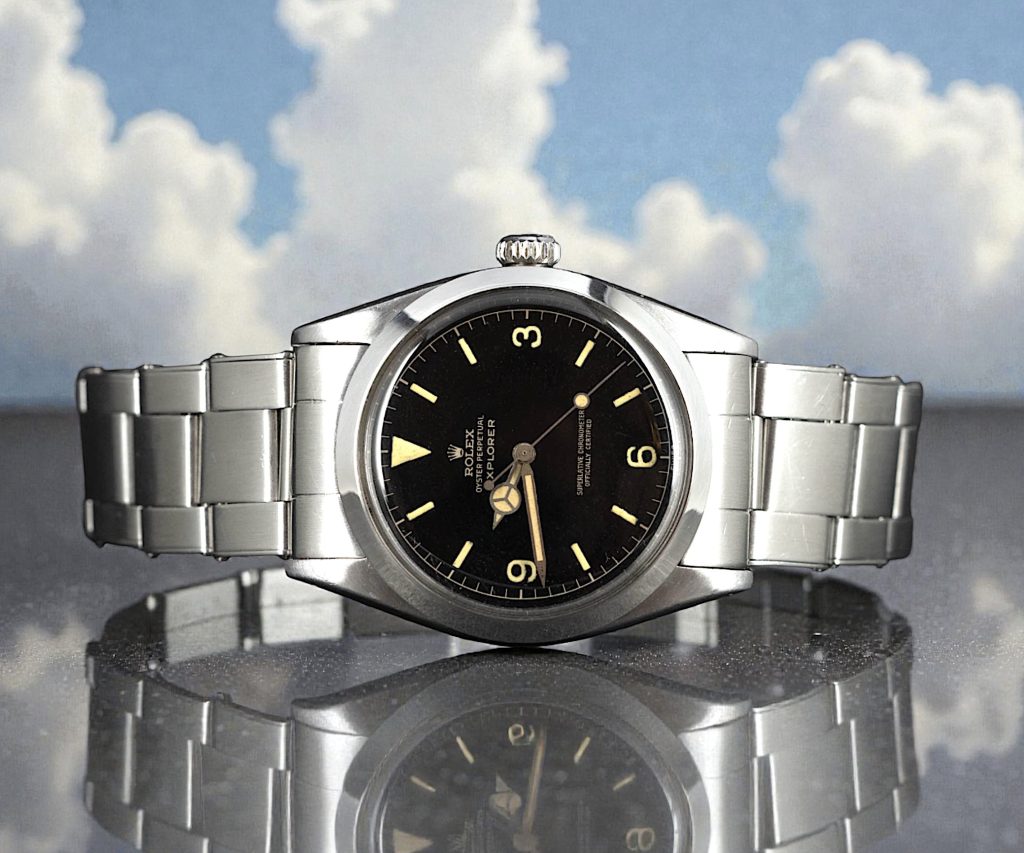
- 36 mm Oyster case in steel
- Smooth bezel, without graduations
- Black dial, extremely legible
- Arabic numerals at 3–6–9, an iconic visual signature
- Mercedes hands
- Water resistance to 100 meters
Two main families of dials fascinate collectors:
- The early “gilt” dials (glossy lacquer, gold lettering)
- The later matte dials, with a utilitarian look
Over time, the tritium on the hour markers develops a unique patina, cream or vanilla, making every example absolutely singular.
Inside the 1016 beats one of Rolex’s most respected calibers:
- Caliber 1560, then 1570
- Automatic movement
- Chronometer certification
- Reputation for exceptional robustness
These calibers were designed to work in difficult conditions, with remarkable accuracy for their time — an essential criterion for explorers… and today for collectors.

Why does the Rolex Explorer 1016 still fascinate?
More than 60 years after its release, the 1016 remains incredibly modern.
It appeals for several reasons:
- Timeless elegance: it wears as well with a suit as with casual clothes
- Total versatility: neither too sporty nor too dressy
- Tool watch authenticity: a watch designed for use, not for marketing
- Growing rarity on the vintage market
- Solid heritage value, steadily increasing
Unlike many contemporary watches, the Explorer 1016 does not try to impress. It commands respect through its discretion.

Collecting an Explorer 1016: Chronostyle’s advice
Before acquiring a 1016, several points deserve particular attention:
Absolutely check
- Originality of the dial (dial replacements are very common)
- Hands and hour markers consistent with the period
- Case (excessive polishing)
- Movement matching the reference
- Bracelet (often replaced, but important for value)
Current market value
Depending on condition, period and originality, a Rolex Explorer 1016 trades today between €15,000 and more than €30,000.
At Chronostyle, we always favor authenticity, history and overall consistency over mere appearance.
A watch, a philosophy
The Rolex Explorer 1016 is not an ostentatious watch. It is a watch for those who know.
It embodies an era when watchmaking answered a real need, when every detail had a function, and when reliability came before effect. To own an Explorer 1016 is to wear a fragment of history on your wrist, a watch born for the extreme and made a myth by its simplicity.